
Findings from the Cheshire East food aid count
I’m penning this on my way back from the latest Feeding Britain networking meeting in Newcastle Upon-Tyne. As always this is time well spent connecting with peers, and finding out more about the incredible work this network is delivering to reduce hunger and poverty across some of the most vulnerable communities across the UK.
The meeting focussed on influencing policy at a local level as well as how community food projects and the communities they support can become more resilient, so both link nicely with this update on the Cheshire East wide food-aid count which took place across 11-17 May.
So, first things first, what do we mean by food aid and how does a food aid-count work?
Food aid is the various forms of support aimed at helping individuals or families in need of foodi. This includes support provided by foodbanks, social supermarkets, community pantries, meal delivery services, community cafés / meals and community fridges.
Those with responsibility for monitoring can attest to how difficult this can be. We took a simple approach we asked projects to record the number of interactions they had with people using a standard reporting template. A similar method has been adopted by Birmingham City Council – so if it’s good enough for them why reinvent the wheel, right! An impressive 80% (n 29) of projects across Cheshire East, took part.
“We’re seeing more families and more people in employment”
So why was the count necessary?
Food insecurity is a public health issue, which can have negative impacts on physical and mental healthii. Those experiencing high deprivation levels are most at risk including those living with children, disabled people, those on benefits and those with insecure migration statusiii.
We had no accurate measure of food insecurity locally, so we don’t have a picture of a place-based need and therefore don’t have the evidence to inform local decision-making and policy interventions, and there are inconsistencies in terms how and what is reported, nationally.
“it’s a quiet time of year so it wouldn’t give a true reflection of the number of people needing support. People don’t need to heat their homes, children are in school being fed, so we are not seeing the number of families we see at the times of year that those things put pressure on households”.
What did the findings tell us;
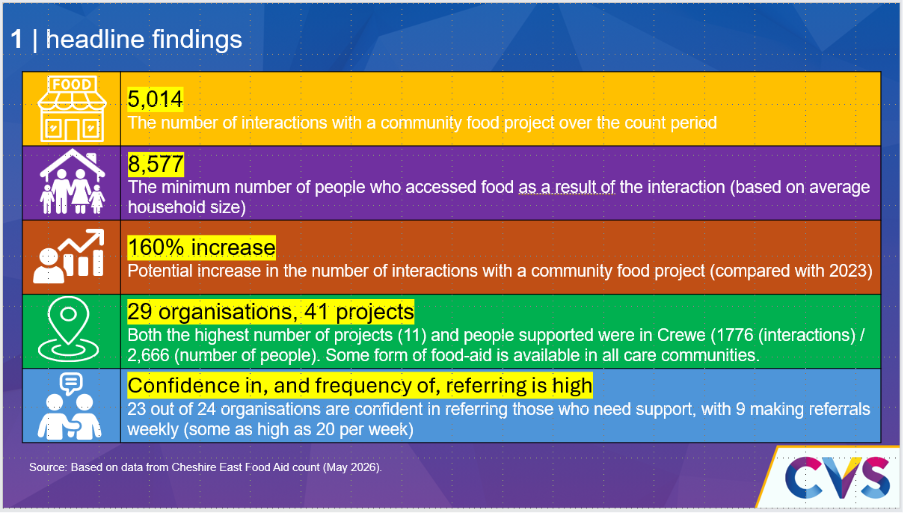
There were 5,014 interactions with a community food project over the count period (160% increase on 2023), leading to 8,577 people accessed food
56% of groups who responded identified an increase in demand (1/3 reported demand was the same
Families (n 4) was the biggest increase by demographic group. But over 70% (n18) of groups indicated they had seen no change in user demographics
Largest number of projects (11) and people supported: 1776 (interactions) / 2,666 (number of people) were in Crewe. Food-aid is available in all care communities. Crewe and Macclesfield combined account for close to 70% of all interventions
More people accessed affordable food support than emergency food support over the count period (authors note: one of the Food Alliance objectives is to reduce foodbank use)
No community based meal delivery service exists in BDP, CHAW, Nantwich or Macclesfield.
“Each time we open we’re referring people to either Citizens Advice, social prescribers, local medical centre”.
Conclusions (with key actions)
Food Insecurity is a public health issue which disproportionally affects some of the most vulnerable residents
There are there are inconsistencies in terms of how and what is reported
Our local data highlights growing demand and provides a benchmark for future measurement (repeat Food aid count across 2027 – 2029)
Community projects are integral to the provision of food aid locally, it wouldn’t exist without them (so we need to continue to invest in them (made this point at the Crisis and Resilience summit)
Other support for those struggling financially is available via Crisis and Resilience Fund (CRF) (we should encourage referrals as well as collectively improving the uptake of all food related support schemes e.g. Healthy Start)
Across the count period groups reported lower levels of demand / operating below capacity (we need to understand why and monitor changes in demand form different demographics e.g. those in work)
Referral levels are high and frequent, situations are complex (suggests needs aren’t being identified) (conversation for the CRF work)
This data can influence CEC decision making both in terms of the work of the Poverty Commission and how the CRF monies are used (findings have been sent to the Council Officers responsible for these programmes of work).
You can read the full report on the CVSCE web page. If you are interested in changing the food system across Cheshire East, then please book at place at our next Food Alliance meeting taking place on 15th September.
